
Chinese Tourism to the Nordics is Back on Track as Visibility Becomes Key

Photo: Juho Luomala / Unsplash; Kokkola, Finland
After several years of disruption, Chinese tourism to the Nordics is entering a new phase. COVID-19 reshaped long-haul travel, while visa processes, air connectivity and geopolitical uncertainty continue to influence how Chinese travellers choose destinations.
However, Nordic destinations remain attractive to Chinese travellers seeking nature, clean environments, distinctive experiences, and places that feel different from traditional European city trips.
As outbound travel from China continues to recover, the question is not only whether travellers are returning. It is also where they are returning, how quickly different Nordic markets are recovering, and whether destinations and tourism businesses are visible when Chinese travellers begin researching their next trip.
A clear rebound in numbers
Chinese travellers are once again spending nights across the Nordics. Guest nights are used because they show where travellers actually stayed, instead of just how many people arrived.
The chart below compares Chinese guest nights in Denmark, Finland, Iceland, Norway and Sweden from 2016 to 2025.
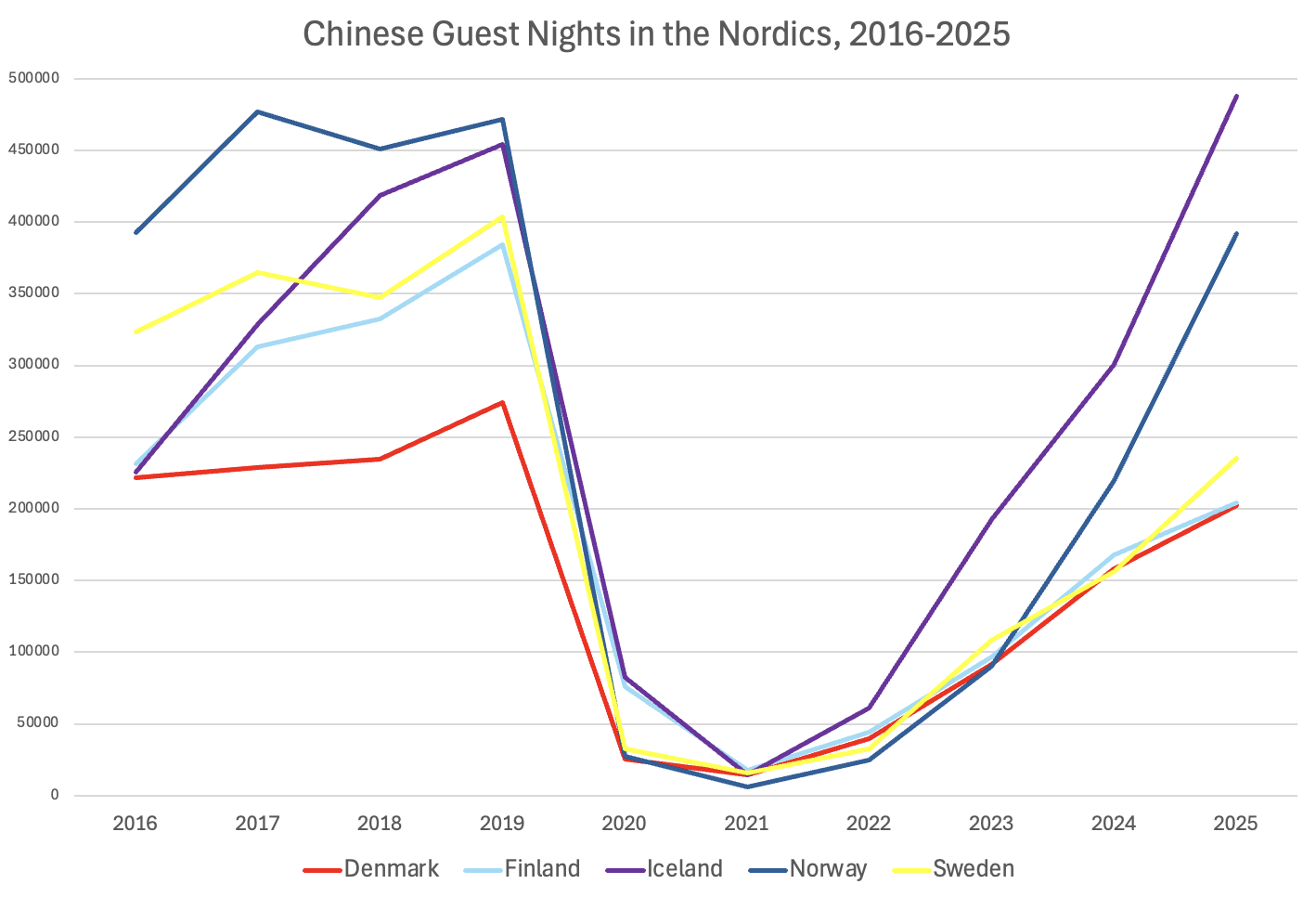
Sources: Statistics Denmark, Statistics Finland, Statistics Iceland, Statistics Norway and Tillväxtverket. Figures refer to Chinese guest nights / overnight stays in registered accommodation. Denmark, Finland, Norway and Sweden classify guests by country of residence, while Iceland uses citizenship.
The overall pattern is clear. Chinese guest nights fell sharply during the pandemic, reached their lowest levels around 2021, and have been recovering since 2023.
However, the pace of growth has differed across the region.
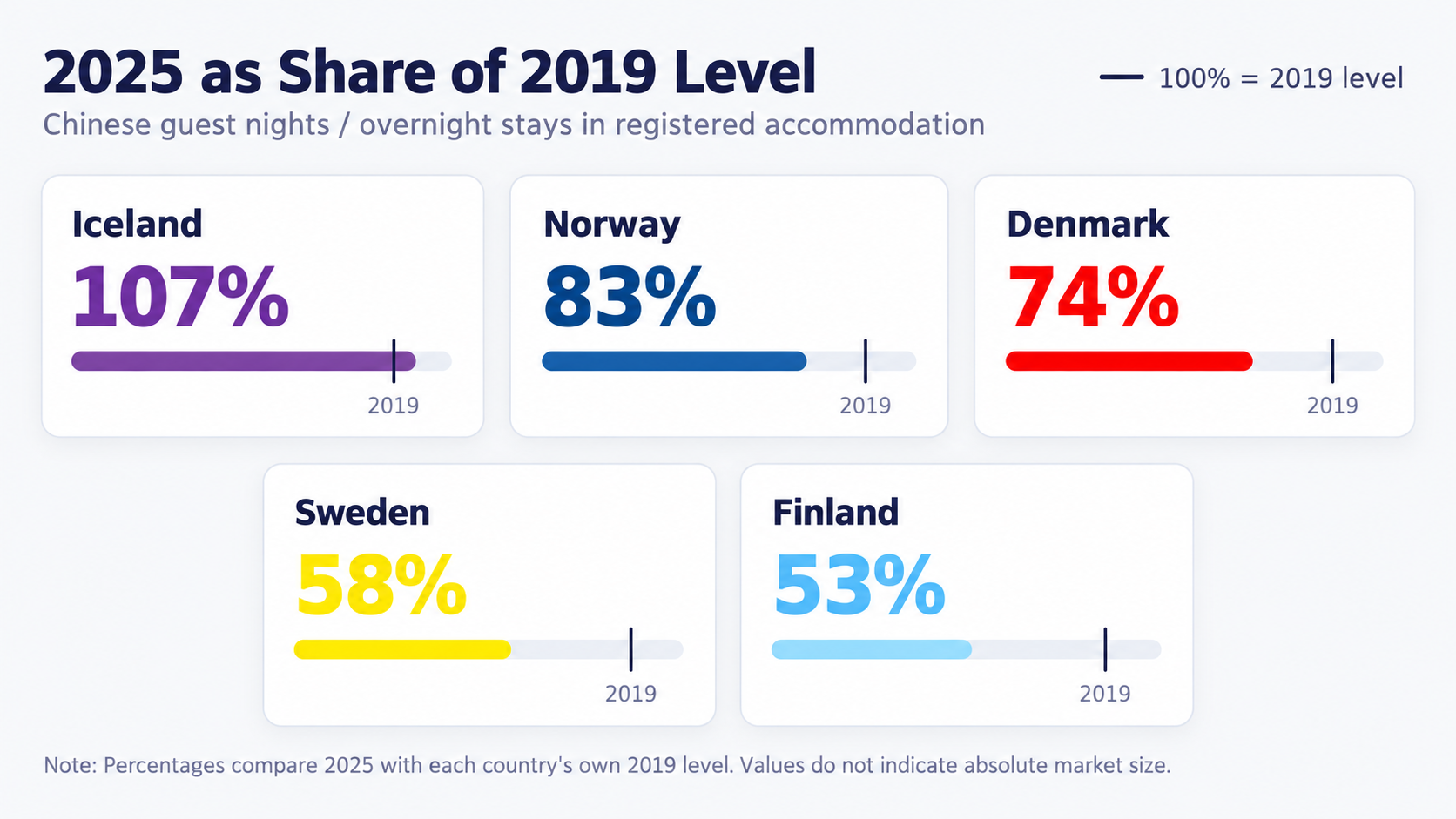
By 2025, Iceland was the only country in this comparison to exceed its 2019 level, reaching 107% of its pre-pandemic figure. Norway had recovered strongly, reaching 83% of its 2019 level, while Denmark reached 74%, Sweden 58% and Finland 53%.
The figures suggest that Chinese tourism to the Nordics is clearly returning, but the regional picture has changed. Some destinations have already returned to or exceeded their pre-pandemic levels, while others remain well below them.
The headline numbers show how Chinese guest nights differ across the Nordics, but looking at each market more closely reveals distinct developments behind them, from new air connections and year-round travel to different seasonal and destination patterns.
Iceland enters a new phase with new flight opportunities
Iceland already stands out in the data. Chinese guest nights reached 487,997 in 2025, around 107% of the 2019 level, making Iceland the only Nordic country in the comparison to move beyond its pre-pandemic figure.
Iceland’s waterfalls, glaciers, volcanic landscapes, road trips and Northern Lights give the destination a highly visual tourism offer, while access from China is also changing. From late October 2026, Air China is scheduled to operate three weekly services between Beijing and Keflavík Airport, with a stop in Copenhagen in both directions. Keflavík Airport describes the new connection as creating new opportunities for tourism, business and cultural exchange between Iceland and China.
For Icelandic tourism businesses, the question is therefore increasingly not whether Chinese travellers are returning, but how to turn stronger accessibility into interest and bookings. Iceland’s waterfalls, glaciers, volcanic landscapes, road trips and Northern Lights give the destination a highly visual tourism offer, while Chinese-language information about seasons, transport, itineraries and booking can help travellers move from inspiration to actual travel planning.
Norway’s appeal is stretching across its seasons
Norway recorded 391,853 Chinese guest nights in 2025, but its appeal goes beyond the overall number. In February 2026, China was Norway’s sixth-largest foreign market, and Innovation Norway reported that Chinese visitors were travelling particularly for Northern Lights experiences, while Oslo also remained an important part of the trip. In February, around 40% of Chinese guest nights were in Nordland and 24% in Tromsø.
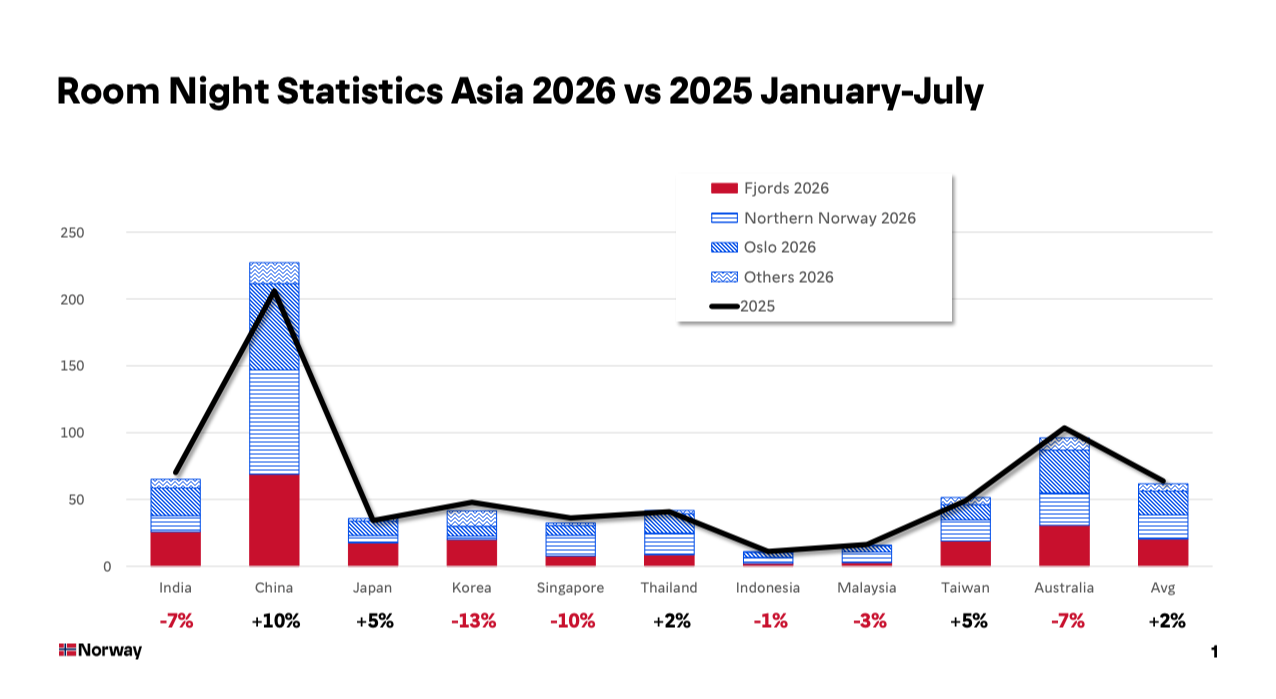
Source: Innovation Norway / Visit Norway, Asia market update, January-July 2026. Figures show room nights in 2026 compared with the same period in 2025.
Norway can also offer very different experiences across the year. Northern Norway shifts from Northern Lights, snow and Arctic winter experiences to hiking, fjords, scenic routes and the midnight sun in summer. In Tromsø, the Northern Lights season runs broadly from September to March, while the midnight sun lasts from late May into July.
For Norwegian tourism businesses, that gives the country something valuable: different reasons to visit in different seasons, with Northern Norway already showing clear interest from Chinese travellers.
Denmark, Sweden and Finland still have room to grow
In 2025, Chinese guest-night totals were relatively close across Sweden at 235,037, Finland at 204,178 and Denmark at 202,307. However, the patterns behind those numbers are different.
Denmark is seeing renewed Chinese growth in 2026. Chinese hotel overnight stays were 52.8% higher in April than a year earlier, according to HORESTA, the Danish hospitality trade association.
Sweden shows a broader seasonal and geographic spread among Chinese visitors. In 2025, around 63% of Chinese guest nights occurred outside June-August, while 30% were recorded outside Greater Stockholm, Gothenburg and Malmö, according to Visit Sweden. A 2026 Mid Sweden University study analysing nearly 500 images and texts from Ctrip and Mafengwo found that more than 70% of the tourism images focused on cultural heritage and urban environments, particularly Stockholm, Gothenburg and Malmö.
Finland has some of the clearest associations in the Chinese market. Visit Finland identifies the Northern Lights, Santa Claus, Finnish education and its “happiest country” image as important draws, while educational travel remains particularly popular among Chinese families.
Chinese travel has returned, but these markets may still have more potential to capture as outbound travel continues to grow.
Recovery creates opportunity, but destinations still need to be digitally visible

The data shows that Chinese travellers are already staying across the Nordics. For individual destinations and tourism businesses, however, the important question is whether they are visible when travellers begin planning their trips.
Digital visibility is one part of that wider picture. Chinese travellers may first encounter a Nordic destination through short videos, travel posts, creator content or recommendations from friends. From there, they may search platforms such as Xiaohongshu for first-hand experiences and compare routes, seasons, costs, attractions and accommodation before making a decision.
For Nordic tourism businesses, this raises a simple question:
When Chinese travellers search for your destination or service, what do they actually find?
A visually attractive destination may create initial interest, but travellers also need practical information before they can turn inspiration into a trip.
They need to understand:
When to visit
How to get there
How long to stay
What the trip may cost
What transport options are available
What kind of experience to expect
Whether the destination fits their travel style
How and where to book
This is where tourism actors need to think beyond general destination promotion, because much of the practical information travellers rely on is found through Chinese digital platforms, travel content and user-generated recommendations.
Turning interest into practical travel information decision-making
For Nordic destinations and tourism businesses, the rebound of Chinese travel creates an opportunity to become more visible and useful throughout the travel-planning process.
That can mean:
Using platforms to build destination awareness
Making practical travel information easy to find in Chinese
Showing real experiences through creators, travellers and local partners
Explaining routes, seasons, weather, transport and booking clearly
Connecting inspiration with enquiry and follow-up through Chinese channels
Treating localisation as a strategic process rather than simply translating existing content
The objective is not only to attract attention, but to make it easier for travellers to move from discovery to research, to confidence, and eventually to booking.
As Chinese outbound travel continues to grow, museums, hotels, attractions, travel organisers and destinations have another opportunity to position themselves within that journey.
For tourism brands and local operators, the next step is to turn returning demand into China-facing visibility, useful content and ultimately conversion.
Unsure how to reach your Chinese audience?
Nordic Friend helps brands understand the Chinese market, localise content and reach travellers across the platforms they use to discover, compare and plan trips.
Through market audits, China-facing webpages, Chinese-language content, platform strategy and advertising, we help brands become visible at the moments when Chinese travellers discover, research and compare destinations.
Visibility is only the starting point. The real value comes when travellers can find the right information, understand the experience and feel confident enough to take the next step.